woensdag 2 oktober 2013

Menstrual Calendar (Lunar or 13 Moon Calendar)


Menstrual Calendar

Two conflicting calendars were used through most of the Christian
era in Europe: the church's official, solar, "Julian" calendar, and the
peasants' unofficial, lunar, Goddess-given menstrual calendar. The
thirteen annuallunations of the latter produced one of the contrasting
answers to the nursery-rhyme riddle: "How many months be in the
year? There be thirteen, I say." Christians produced another answer:
"There be but twelve, I say." The lunar calendar's thirteen 28-day
months had four 7-day weeks apiece, marking new, waxing, full, and
waning moon-sabbaths in the ancient form. Weeks are still lunar, but
they no longer fit neatly into the solar month system. Thirteen lunar
months gave 364 days per year (13 X 28), with one extra day to
make 365. Nursery rhymes, fairy tales, witch charms, ballads and other
repositories of pagan tradition nearly always describe the full annual
cycle as "a year and a day."
It has been shown that calendar consciousness developed first in
women, because of their natural menstrual body calendar, correlated
with observations of the moon's phases. Chinese women established a
lunar calendar 3000 years ago, dividing the celestial sphere into 28
stellar "mansions" through which the moon passed. Among the
Maya of central America, every woman knew "the great Maya calendar
had first been based on her menstrual cycles." 1 Romans called the
calculation of time mensuration, i.e., knowledge of the menses. Gaelic
words for "menstruation" and "calendar" are the same: miosach and
miosachan. The new-moon sabbaths of ancient Latium were kalends,
possibly related to the Aryan name of Kali. For fear of disrupting the
Goddess's transitions, activities of some kinds were forbidden on the
seventh day of each lunar phase; thus sabbaths became "unlucky" or
taboo. Because it was the time-honored custom, even the biblical God
was forced to "rest" on the seventh day.
One of the prototypes of Yahweh was the Babylonian god Marduk,
who divided the maternal "waters" into those above and below
the firmament (Genesis 1: 7). Marduk claimed to be the creator, but was
not yet so patriarchal as to abandon his Mother's lunar calendar.
Babylonian priests said Marduk established holy days and seasons by the
moon.2 Yet older traditions said the menstrual calendar was instituted
in Babylon by the god Nabu-Rimmani, the biblical Baai-Rimmon, a
phallic deity united with the Great Mother's yoni in the form of a
pomegranate. 3
The Chinese explained their menstrual calendar with the myth of
the holy calendar plant, lik-kiep, on which a pod grew every day for
14 days, then a pod fell off every day for 14 days. When the months became
confused by solar reckoning, the Chinese added extra days
when "a pod withered without falling off." 4
According to another story, the menstrual calendar was called
Hsiu, "Houses." The Moon Mother rested each night of the lunar
month in a different one of her 28 houses, which were kept by the 28
warrior-hero consorts she had placed in heaven to attend her.5
The ancient Hebrews took their calendar from Chaldea, legendary
home of Abraham, whose older name was Ab-sin, "Moon-father." 6
Chaldeans were credited with the invention of astrology, now largely
based on the movements of the sun; but the Chaldeans didn't study
the sun. They were "Moon-worshippers," believing the moon determined
the fates of men by her movements through various "houses"
of the zodiac. The same lunar myths were found in Egypt, northern
Europe, Greece, and Rome. Latin kings were sacrificed at the threeday
dark of the moon period called ides, to insure the Goddess's safe
return from the underworld. Greeks similarly made offerings at the
Great Sabbath called Noumenia (New Moon). The other Great Sabbath
was Dichomenia (Full Moon), when the Goddess stood at the
peak of her cycle. 7
Early attempts at calendar reform left Greek city-states quarreling
among themselves about sabbaths and intercalary days. Aristophanes'
s The Clouds makes the Moon-goddess complain that her
reckoning of the days was not being correctly followed. 8 Time-spans
in myths became confused. Adonis was born after "ten months' gestation,"
which really meant ten lunar months, the normal 280 days.9
According to the Book of Maccabees, every gestation lasted ten
months.10 This wasn't ignorance; it was just lunar reckoning.
Even the saints' days of the medieval church were established by
menology, literally "knowledge of the moon." The church's so-called
movable feasts were movable because they were determined by lunar
cycles, not solar ones; thus they drifted erratically through the months
of the canonical calendar. The most important of them, Easter, is still
determined by the moon (first Sunday after the first full moon after
the spring equinox), at a time when the Goddess slew and re-conceived
the Savior or vegetation god for a new season. 11
More confusion was created by the fact that menstrual calendars
reckoned the day from noon to noon, with the midnight hour in the
central position; but solar calendars reckoned the day from midnight to
midnight. The Saxon word den (day) really meant "night." In
Shakespeare's time, people said goodnight by wishing each other good
den, literally good moon-day. Old French nursery rhymes greeted
the moon rising in the evening with "Good morning, Madame
Moon." 12 The meridian or high point of noon used to indicate the
full moon overhead at midnight: hence its name Meri-Dia or MaryDiana,
the Moon-goddess. Superstitious folk talked of the
daemonium meridian urn, devil of the meridian, a diabolization of the
Goddess.13 She was probably the second of the Slavic trinity of Fates
(Zorya), called "She of the Evening, She of Midnight, and She of
Morning," in that order. 14
Pagans held their festivals at night, by moonlight: a custom that
might be traced as far back as ancient Egypt, where major religious
ceremonies were nocturnal, as listed in the Book of the Dead:
The night of the battle and of the overthrow of the Sebau-field in Tattu
... , the night of making to stand up the double Tet in Sekhem ... , the
night of establishing Horus in the heritage of the things of his father in
Rekhti . .. , the night when Isis maketh lamentation at the side of her
brother Osiris in A btu ... , the night of the Haker festival when a division
is made between the dead ana the spirits who are on the path of the dead
... , the night of the judgment of those who are to be annih1lated at the
great festival ofthe ploughing and the turning up of the earth. 15
Pre-Christian Europe also gave night precedence over day . .
Germanic tribes, Celts, Gauls, druids, the ancient Irish calculated
"months, years, and birthdays in such a way as to make the night
precede the day." 16 Caesar noted that the Celts measured time by
nights instead of by days.'7
Christian holy days were copied from pagan ones, displaced by 12
hours in their solar reckoning; therefore the older, heathen version of
each festival was celebrated on the "Eve" of its Christian counterpart.
From this arose the so-called devilish rites of May Eve, Midsummer
Eve, Lammas Eve, All Hallow's Eve, and Christmas Eve which was
taken from the pagan Yule, and to a late date was still called the
Night of the Mother.'s
Witch persecutors pretended the witches copied their sabbats from
Christian feast days in deliberate mockery of the church; but in fact
the copying had gone in the other direction. The church took over the
pagan feasts of Halloween, May Day, Lammas, lmbolg, Midsummer,
Easter, Yule, and so on, then claimed to have invented them.
However, of the two rival festivals on the same day, the Christian one
was invariably the newcomer.19
May Eve was the Saxons' Walpurgisnacht, the Celts' Beltain,
announcing the opening of the Merry Month of sexual license and
"wearing of the green" in honor of the earth's new spring garment. The
occasion was still marked by pagan ceremonies in the late 16th
century.20 (See May.) Midsummer Eve merged with St. John's Day,
but the solstitial rites remained more pagan than Christian. Lammas
Eve was a witches' Great Sabbat because it was formerly the pagan
Feast of Bread (Hlaf..mass) in honor of the Corn-mother.21 Halloween
was All Hallows' or All Souls' eve, from the Celtic Samhain or
Feast of the Dead, when pagan ancestors came forth from their fairymounds,
and Christians called them "demons" who attended the
witches' feasts. 22
The thirteen months of the menstruat calendar also led to
pagan reverence for the number 13, and Christian detestation of it.
Witches' "covens" were supposed to be groups of l3 like the moonworshipping
dancers of the Moorish zabat (sabbat), to whom thirteen
expressed the three-in-one nature of the lunar Goddess.23
Some said thirteen was a bad number because Christ was the
thirteenth in the group of apostles, thus the thirteenth member of any
group would be condemned to death. Actually, it was the church's
opposition to pagan symbolism that brought opprobrium on the
number 13. Some even feared to speak its true name, and it was
euphemized as a "baker's dozen," or sometimes "devil's dozen." 24
The heathen tradition persisted in such symbols as the Thirteen
Treasures of Britain, probably lunar-month signs taken from a primitive
list of zodiacal constellations. They were defined as a sword, basket,
drinking horn, chariot, halter, knife, cauldron, whetstone, garment,
pan, platter, chessboard, and mantle.25 The thirteen menstrual months
were symbolized in the Tarxien temple on Malta as a sow with 13
teats, like the Celts' Sow-goddess Cerridwen.26 Thirteen "moons" of
the menstrual calendar were suggested also by the English Twelfth
Night custom ofkindling twelve small fires and one large one, to
represent the moon of the New Year. 27
In general, the symbols of ancient matriarchy came to be known as
night, the moon, and the number 13, while those of patriarchy were
day, the sun, and the number 12.

Sabbat, Witches'

Some derive "sabbat" from the Moorish zabat, "an occasion of
power," at which Berber descendants of north African "Amazons" still
perform sacred dances in groups of 13-the traditional number of
the witches' coven-for the 13 annuallunations.1
The European sabbat or festival was fabricated largely by judges of
the Inquisition during the 14th and 15th centuries, on a foundation
of pagan precedents. Churchmen said witches held four Great Sabbats a
year "in derision of the four annual festivals of the Church"; but the
church had copied these from the pagans in the first place. 2 They were:
(1) Candlemas Eve; (2) May Eve, or Walpurgisnacht; (3) Lammas
Eve; and (4) Halloween. Some lists included Midsummer (the Feast of
St. John) and the solstitial festival on December 21 (the Feast of St.
Thomas).3
Details were drawn from classical descriptions of Roman fertility
festivals, such as the Bacchanalia, Saturnalia, Lupercalia, etc. At the
ancient ceremony of purification for the New Year, in the Lupercal
grotto where Lupa the She-Wolf was said to have suckled Romulus
and Remus, he-goats were sacrificed and youths were touched with the
blood; priests in raw goatskins struck women's hands with strips of
goatskin as a fertility charm; men and women exchanged clothing and
engaged in orgiastic sex. Late in the 5th century, this Lupercalia was
adopted into the Christian calendar and renamed the Feast of Purification
of the Virgin.4
Other pagan practices supposedly incorporated into the witches'
sabbat included widdershins (counterclockwise) dancing in a ring, in
honor of the Moon-goddess; wearing masks; jumping over fires; sacrificial
feasting; worshipping ~rees, springs, and sacred stones; and
making lewd jokes and horseplay in a carnival atmosphere. Indeed the
Carnival, or Feast of Fools, descended from pagan holidays when the
social order was temporarily reversed, and everything was done backward,
a prototype of the "reverse Christianity" of the Black Mass.
The Saturnalia was still kept by medieval Christians in this manner:
The priests of a church elected a bishop of fools, who came in full pomp,
placing himselfin the episcopal seat in the choir. High mass then
began; all the ecclesiastics assisted, their faces smeared with blacking, or
covered with a hideous or ridiculous mask. During the course of the
celebration, some of them, dressed like mountebanks or in women's
clothes, danced in the middle of the choir, singing clownish or obscene
songs. Others ate sausages or puddings from the altar, played at cards or at
dice in front of the oRiciating priest, incensed him with the censer, or,
burning old shoes, made him breathe the smoke. 5
Such carnival clownishness was "simply the last form which the
Priapeia and Liberalia assumed in Western Europe, and in its various
details all the incidents of those great and licentious orgies of the
Romans were reproduced."6 However, certain authorities came to
perceive such revels as profoundly evil. In 1445 the Paris Faculty of
Theology called for reform, writing to the French bishops a puritanically
shocked description of pre-Lenten customs: "Priests and clerks
may be seen wearing masks and monstrous visages at the hours of office.
They dance in the choir dressed as women, panders or minstrels.
They sing wanton songs. They eat black puddings at the horn of the
altar while the celebrant is saying Mass. They play at dice there.
They cense with stinking smoke from the soles of old shoes. They run
and leap through the church, without a blush at their own shame." 7
Copies ofletters like this one, drawn from the archives, surely gave
the Inquisition's judges many ideas for details of the Sabbat that they
put in the mouths of their victims, and confirmed by torture. With only
minimal imagination, a judge could reverse any ordinary church
service and accuse his victim of kissing the devil' s anus (instead of the
bishop's ring), eating children's corpses and drinking menstrual blood
(instead of bread and wine), saying the prayers backward, making the
sign of the cross with the left foot instead of the right hand, addressing
subterranean deities instead of celestial ones, and so on.
Weekly sabbats were supposed to be held on Friday, once a lunar
"Eve" of the original sabbath, the day of Saturn or of Zeus Sabazius.
Friday was the day-sacred to Venus-Freya, and after sunset it was the
Jews' sabbath day, both of which made it a bad or unlucky day in
Christian opinion. Friday the 13th was especially ill-favored.

From Barbara Walker's Women's Encyclopedia of Myths and Secrets


 The Wheel of the Year is an annual cycle of seasonal festivals in contemporary Paganism. It consists primarily of eight festivals based around the solstices and equinoxes, known as the quarter days, and the midpoints between, known as the cross quarter days.
Within Paganism, many festivals are celebrated. They can vary considerably in name and date amongst specific traditions, however the eight festivals of the Wheel comprise the most adhered and important annual celebrations. They are a unifying feature of modern Paganism. The Wheel has been important to many people, both ancient and modern, and its festivals are based to varying degrees on folk tradition.[1]
The festivals are also referred to as sabbats /ˈsæbət/, the term being explained as passed down from the Middle Ages, when the terminology for Jewish Shabbats was commingled with that of other heretical celebrations.

The festivals

In Pagan cosmology, all things are considered to be cyclical — including the year. It is understood as a perpetual cycle of growth and retreat tied to the Sun's annual death and rebirth. This cycle is also viewed as a micro- and macrocosm of other life cycles in an immeasurable series of cycles composing the Universe. The days that fall on the landmarks of the yearly cycle traditionally mark the beginnings and middles of the four seasons. They are regarded with significance and host to major communal festivals. These eight festivals are the most common times for community celebrations.
While the major festivals are determined by quarter and cross-quarter days, many minor festivals are also celebrated throughout the year amongst various traditions. Additionally, festivals (major or minor) may not enjoy the same level of significance from one tradition to another.
The festivals, being tied to solar movements, have always been steeped in solar mythology and symbolism, centred around the life cycles of the sun. Similarly, the esbats are traditionally tied to the lunar cycles. Together, they represent the most common and important celebrations in modern Paganism, especially in Witchcraft.

Midwinter/Winter Solstice/Yule

The most universally celebrated festival is that of Midwinter. It has been recognized as a significant turning point in the yearly cycle since the late Stone Age. The ancient megalithic sites of Newgrange and Stonehenge, carefully aligned with the solstice sunrise and sunset, exemplify this. The reversal of the Sun's ebbing presence in the sky symbolizes the rebirth of the solar god and presages the return of fertile seasons. From Germanic to Roman tradition, this is the most important time of celebration.
Practices vary, but sacrifices, feasting, and gift giving are common elements of Midwinter festivities. Bringing sprigs and wreaths of evergreenery (such as holly, ivy, mistletoe, yew, and pine) into the home and tree decorating are also common during this time.
This liminal festival marks the last month of the old year and the first month of the new year and is followed by eleven days of extended celebration in Germanic tradition. In Roman tradition additional festivities take place during the six days leading up to Midwinter. The celebration of Christmas during approximately the same time is the result of early Christianity's adaptations of popular pre-Christian festivals concerning the winter solstice.

Imbolc/Candlemas

As the first cross-quarter day following Midwinter, this traditionally marks winter's end and spring's start. It is time for purification and spring cleaning in anticipation of the year's new life. It was historically a shepherd's holiday and among Celts associated with the onset of ewes' lactation, prior to birthing the spring lambs.
The festival is strongly associated with Brigid, daughter of The Dagda and one of the Tuatha Dé Danann.
Among Reclaiming tradition Witches, this is the traditional time for pledges and rededications for the coming year and for initiation among Dianic Wiccans.

Vernal equinox/Ostara/Spring Equinox

The vernal equinox, often called Ostara, inaugurates the new year on the Zodiacal calendar. From this point the day overcomes the night. It is widely recognized by many mythologies as the time of rebirth or return for vegetation gods (e.g. Attis) and is celebrated as a time of great fertility.
Egg decorating is a very common tradition in vernal celebration throughout Europe.
The holiday is strongly associated with fertility goddess Ostara (the eastern star). She is notably associated with the fecund symbols of the hare and egg. Her teutonic name may be etymological ancestor of the words east and Easter.

Beltane/Walpurgis Night/Floralia/May Eve

Traditionally the first day of summer, the earliest celebrations appeared in pre-Christian times with the festival of Flora, the Roman goddess of flowers, and the Walpurgis Night celebrations of the Germanic countries. It is also strongly associated with the Gaelic Beltane (bright fire).
Since the Christianization of Europe, a more secular version of the festival has continued in Europe and America. In this form, it is well known for maypole dancing and the crowning of the Queen of the May.

Midsummer/Summer solstice/Litha

Midsummer is one of the four solar holidays, and is considered the turning point at which summer reaches its height and the sun shines longest. Among the Wiccan sabbats, Midsummer is preceded by Beltane, and followed by Lammas or Lughnasadh.
Some traditions call the festival Litha, a name occurring in Bede's Reckoning of Time (De Temporum Ratione, 7th century), which preserves a list of the (then-obsolete) Anglo-Saxon names for the twelve months. Ærra Liða (first or preceding Liða) roughly corresponds to June in the Gregorian calendar, and Æfterra Liða (following Liða) to July. Bede writes that "Litha means gentle or navigable, because in both these months the calm breezes are gentle and they were wont to sail upon the smooth sea".

Lammas/Lughnasadh/August Eve

Lammas or Lughnasadh (/ˈluːnæsə/ LOO-nas-ə) is the first of the three Pagan autumn harvest festivals, the other two being the autumnal equinox (or Mabon) and Samhain. Wiccans mark the holiday by baking a figure of the god in bread and eating it, to symbolize the sanctity and importance of the harvest. Celebrations vary, as not all Pagans are Wiccans. The Celtic name Lughnasadh is used in some traditions to designate this holiday. Wiccan celebrations of this holiday are neither generally based on Celtic culture nor centered on the Celtic deity Lugh. This name seems to have been a late adoption among Wiccans. In early versions of Wiccan literature the festival is referred to as August Eve.
The name Lammas (contraction of loaf mass) implies it is an agrarian-based festival and feast of thanksgiving for grain and bread, which symbolizes the first fruits of the harvest. Pagan rituals may incorporate elements from either festival.

Autumnal equinox/Mabon/Fall Equinox

The holiday of the autumnal equinox, Harvest Home, Mabon, the Feast of the Ingathering, Meán Fómhair or Alban Elfed (in Neo-Druidic traditions), is a Pagan ritual of thanksgiving for the fruits of the earth and a recognition of the need to share them to secure the blessings of the Goddess and the God during the coming winter months. The name Mabon was coined by Aidan Kelly around 1970 as a reference to Mabon ap Modron, a character from Welsh mythology. Among the sabbats, it is the second of the three Pagan harvest festivals, preceded by Lammas / Lughnasadh and followed by Samhain.

Samhain/Hallows/November Eve

Samhain (/ˈsɑːwɪn/ SOW-in) is considered by Wiccans to be one of the four Greater Sabbats. Samhain is considered by some as a time to celebrate the lives of those who have passed on, and it often involves paying respect to ancestors, family members, elders of the faith, friends, pets, and other loved ones who have died. In some rituals the spirits of the departed are invited to attend the festivities. It is seen as a festival of darkness, which is balanced at the opposite point of the wheel by the festival of Beltane, which is celebrated as a festival of light and fertility.
Wiccans believe that at Samhain the veil between this world and the afterlife is at its thinnest point of the whole year, making it easier to communicate with those who have left this world.

Minor festivals

In addition to the eight major holidays common to most modern Pagans, there are a number of minor holidays during the year to commemorate various events.
The minor holidays common in contemporary Germanic Paganism:
Vali's Blot, celebration dedicated to the god Váli and to love — 14 February
Feast of the Einherjar, celebration to honor kin who died in battle — 11 November
Ancestors' Blot, celebration of one's own ancestry or the common ancestors of a Germanic ethnicity — 11 November
Yggdrasil Day, celebration of the world tree Yggdrasil, of the reality world it represents, of trees and nature — 22 April
Winterfinding, celebration which marks the beginning of winter, held on a date between Haustblot and Winternights (mid-October)
Summerfinding, celebration which marks the beginning of summer, held on a date between Ostara and Walpurgisnight (mid-April)

Dates of celebration

The precise dates on which festivals are celebrated are often flexible. Dates may be on the days of the quarter and cross-quarter days proper, the nearest full moon, the nearest new moon, or the nearest weekend for secular convenience. The festivals were originally celebrated by peoples in the middle latitudes of the Northern Hemisphere. Consequently, the traditional times for seasonal celebrations do not agree with the seasons in the Southern Hemisphere or near the equator. Pagans in the Southern Hemisphere often advance these dates by six months to coincide with their own seasons.

Practice

Celebration commonly takes place outdoors in the form of a communal gathering.

Sacrifice

Offerings of food, drink, various objects, the lives of animals, etc. have been central in ritual propitiation and veneration for millennia. The most notorious of these, ritual slaughter and sacrificing of animals has historically been common in any major settings that allowed for it, as blood sacrifices were known to be the most potent of all offerings. However, its use has always been tenuous and modern Pagan practice strongly avoids sacrificing animals in favour of grains, herbs, milk, wines, incense, baked goods, minerals, etc. The exception being with ritual feasts including meat, where the inedible parts of the animal are often burned as offerings while the community eats the rest.
Sacrifices are typically offered to gods and ancestors by burning them. Burying and leaving offerings in the open are also common in certain circumstances. The purpose of offering is to benefit the venerated, show gratitude, and give something back, strengthening the bonds between humans and divine and between members of a community.

Origins

The contemporary Wheel of the Year is somewhat of a modern innovation. While many historical pagan traditions celebrated various equinoxes, solstices, and even cross-quarter days for their seasonal and agricultural significances, none were known to have held all eight above all other annual, sacred times. The modern understanding of the Wheel is a result of the cross-cultural awareness that began developing by the time of Modern Europe.
Mid-20th century British Paganism had a strong influence on early adoption of an eightfold Wheel. By the late 1950s, the Wiccan Bricket Wood Coven and Order of Bards, Ovates and Druids had both adopted eightfold ritual calendars, for balance and more frequent celebrations. This also had the benefit of more closely aligning celebration between the two influential Pagan orders.
Due to early Wicca's influence on Paganism and their syncretic adoption of Anglo-Saxon and Celtic motifs, the most commonly used English festival names for the Wheel of the Year tend to be Celtic and Germanic.
The American Ásatrú movement has adopted, over time, a calendar in which the Heathen major holidays figure alongside many Days of Remembrance which celebrate heroes of the Edda and the Sagas, figures of Germanic history, and the Viking Leif Ericson, who explored and settled Vinland (North America). These festivals are not, however, as evenly distributed throughout the year as in Wicca and other Heathen denominations.

Narratives

Modern Wicca and Neo-druidism

In Wicca, the narrative of the Wheel of the Year traditionally centres on the sacred marriage of the God and the Goddess and the god/goddess duality. In this cycle, the God is perpetually born from the Goddess at Yule, grows in power at the vernal equinox (as does the Goddess, now in her maiden aspect), courts and impregnates the Goddess at Beltane, reaches his peak at the summer solstice, wanes in power at Lammas, passes into the underworld at Samhain (taking with him the fertility of the Goddess/Earth, who is now in her crone aspect) until he is once again born from Her mother/crone aspect at Yule. The Goddess, in turn, ages and rejuvenates endlessly with the seasons, being courted by and giving birth to the Horned God.
Many Wiccan, Neo-Druid, and eclectic Neopagans incorporate a narrative of the Oak King and the Holly King as rulers of the waxing year and the waning year respectively. These two figures battle endlessly with the turning of the seasons. At the summer solstice, the Holly King defeates the Oak King and commences his reign. After the Autumn equinox the Oak King slowly begins to regain his power as the sun begins to wane. Come the winter solstice the Oak King in turn vanquishes the Holly King. After the spring equinox the sun begins to wax again and the Holly King slowly regains his strength until he once again defeats the Oak King at the summer solstice. The two are ultimately seen as essential parts of a whole, light and dark aspects of the male God, and would not exist without each other.
The Holly King is often portrayed as a woodsy figure, similar to the modern Santa Claus, dressed in red with sprigs of holly in his hair and the Oak King as a fertility god.


HIldegard of Bingen


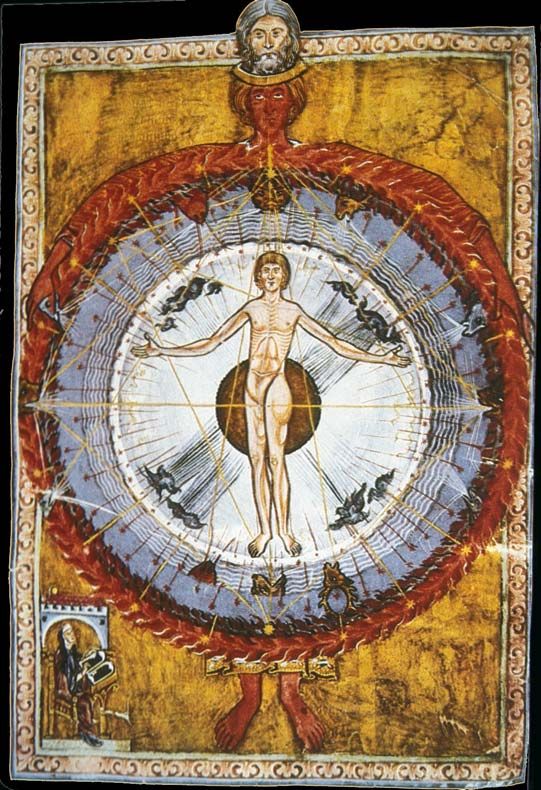
Hildegard de Bingen (1098-1179) was born into a wealthy family in Germany, birth date not quite certain. She was her parents tenth child, and had 'visions' , the earliest when she was about three years old. Her parents didn't know what to do with her, so they shipped her off to a convent when she was eight. This was the best thing that could have happened to her. Convents were the only places females had access to education. She was taken under the wing of a nun named Jutta, who became her teacher and mentor. She was very intelligent, learned to read, write, create illuminated manuscripts, play and compose music, etc... This painting above is her receiving one of her visions from God. Her friend, a monk named Volmar, who became her secretary, watches. (Yes, she was a female with a male assistant!)


All of Hildegarde's paintings are from her visions. They all rethink the doctrines of the Catholic church from a female, matriarchal perspective. This one is called Forms of the Church, it's a giant Eve there, holding her Sisters of Wisdom in her arms. Girl power all the way!!


Some of her paintings remind me of mandalas. This one is called The Cosmic Egg, like a woman's womb, it shows the universe surrounded by fire, the blue is the sky, in the center are the four elements, bringing nutrients to the entire 'egg'. She said,'woman may be made from man, but no man can be made without a woman'.


Hildegard went on to become the head of her convent, the Abbey of Rupertsberg.  Women flocked to join her in droves. Her visions were 'approved' by the pope, and she was given considerable power. When she wanted more independence, she moved her whole convent away from a nearby monastery. Her community flourished. She wrote nine books, plays, composed music. She lived into her 80s.


Jonah Winter wrote a children's book about her, The Secret World of Hildegard, illustrated by his mom, Jeanette Winter.

why do women menstruate .. ?


Menstruation is a peculiar phenomenon that women go through on a roughly monthly cycle, and it’s not immediately obvious from an evolutionary standpoint why they do it. It’s wasteful — they are throwing away a substantial amount of blood and tissue. It seems hazardous; ancestrally, in a world full of predators and disease, leaving a blood trail or filling a delicate orifice with dying tissue seems like a bad idea. And as many women can tell you, it’s uncomfortable, awkward, and sometimes debilitating. So why, evolution, why?
One assumption some people might make is that that is just the way mammalian reproduction works. This isn’t true! Most mammals do not menstruate — they do not cycle their uterine linings, but instead only build up a thickened endometrium if fertilization occurs, which looks much more efficient. Of the mammals, only most primates, a few bats, and elephant shrews are among the lucky animals that menstruate, and as you can see from the phylogeny, the scattered diversity of menstruating mammals implies that the trait was not present ancestrally — we primates acquired it relatively late.


Phylogeny showing the distribution of menstruation in placental mammals and the inferred states of ancestral lineages. Menstruating species/lineages are colored in pink, non- menstruating species/lineages in black. Species in which the character state is not known are not colored, and lineages of equivocal state are represented with black lines. Monodelphis represents the outgroup. Inference of ancestral states was performed in MacClade 4 by the parsimony method. Note that there is strong evidence for three independent originations of menstruation among placental mammals.
I suppose we could blame The Curse on The Fall, but then this phylogeny would suggest that Adam and Eve were part of a population of squirrel-like proto-primates living in the early Paleocene. That’s rather unbiblical, though, and what did the bats and elephant shrews do to deserve this?
There are many explanations floating around. One is that it’s a way to flush out nasty pathogens injected into the reproductive tract by ejaculating males — but that phenomenon is ubiquitous, so you have to wonder why only a few species bother. Another explanation is that it’s more efficient to get rid of the endometrium when not using it, than to maintain it indefinitely; but this is a false distinction, because other mammals don’t maintain the endometrium, they just build it up in response to fertilization. And finally, another reason is that humans have rather agressive embryos that implant deeply and intimately with the mother’s tissues, and menstruation “preconditions” the uterine lining to cope with the stress. There is, unfortunately, no evidence that menstruation provides any boost to the ‘toughness’ of the uterus at all.
A new paper by Emera, Romero, and Wagner suggests an interesting new idea. They turn the question around: menstruation isn’t the phenomenon to be explained, decidualization, the production of a thickened endometrial lining, is the key process.
All mammals prepare a specialized membrane for embryo implantation, the difference is that most mammals exhibit triggered decidualization, where the fertilized embryo itself instigates the thickening, while most primates have spontaneous decidualization (SD), which occurs even in the absence of a fertilized embryo. You can, for instance, induce menstruation in mice. By scratching the mouse endometrium, they will go through a pseudopregnancy and build up a thickened endometrial lining that will be shed when progesterone levels drop. So the reason mice don’t menstruate isn’t that they lack a mechanism for shedding the endometrial lining…it’s that they don’t build it up in the first place unless they’re actually going to use it.
So the question is, why do humans have spontaneous decidualization?
The answer that Emera suggests is entirely evolutionary, and involves maternal-fetal conflict. The mother and fetus have an adversarial relationship: mom’s best interest is to survive pregnancy to bear children again, and so her body tries to conserve resources for the long haul. The fetus, on the other hand, benefits from wresting as much from mom as it can, sometimes to the mother’s detriment. The fetus, for instance, manipulates the mother’s hormones to weaken the insulin response, so less sugar is taken up by mom’s cells, making more available for the fetus.
Within the mammals, there is variation in how deeply the fetus sinks its placental teeth into the uterus. Some species are epithelochorial; the connection is entirely superficial. Others are endotheliochorial, in which the placenta pierces the uterine epithelium. And others, the most invasive, are hemochorial, and actually breach maternal blood vessels. Humans are hemochorial. All of the mammalian species that menstruate are also hemochorial.
That’s a hint. Menstruation is a consequence of self-defense. Females build up that thickened uterine lining to protect and insulate themselves from the greedy embryo and its selfish placenta. In species with especially invasive embryos, it’s too late to wait for the moment of implantation — instead, they build up the wall pre-emptively, before and in case of fertilization. Then, if fertilization doesn’t occur, the universal process of responding to declining progesterone levels by sloughing off the lining occurs.
Bonus! Another process that goes on is that the lining of the uterus is also a sensor for fetal quality, detecting chromosomal abnormalities and allowing them to be spontaneously aborted early. There is some evidence for this: women vary in their degree of decidualization, and women with reduced decidualization have been found to become pregnant more often, but also exhibit pregnancy failure more often. So having a prepared uterus not only helps to fend off overly-aggressive fetuses, it allows mom a greater ability to be selective in which fetuses she carries to term.
The authors also have a proposed mechanism for how menstruation could have evolved, and it involves genetic assimilation. Genetic assimilation is a process which begins with an environmentally induced phenotype (in this case, decidualization in response to implantation), which is then strengthened by genetic mutations that stabilize the phenotype — phenotype first, followed by selection for the mutations that reinforce the phenotype. They make predictions from this hypothesis. In species that don’t undergo SD, embryo implantation triggers an elevation of cyclic AMP in the endometrium that causes growth of the lining. If genetic assimilation occurred, they predict that what happened in species with SD was the novel coupling of hormonal signaling to the extant activation process.
If either of these models were correct, we would expect an upregulation of cAMP- stimulating agents in response to pro- gesterone in menstruating species like humans, but not in non-menstruating species such as the mouse.
Results from experiments like those described above will elucidate the evolutionary pathway from induced to spontaneous decidualization, allowing us to answer long-unanswered questions about the evolutionary significance of menstruation. In addition, they will provide mechanistic insights that might be useful in the treatment of common reproductive disorders such as endometriosis, endometrial cancer, preeclampsia, and recurrent pregnancy loss. These disorders involve dysfunctional endometrial responses during the menstrual cycle and pregnancy. Thus, clarifying mechanisms of the normal endometrial response to maternal hormones, i.e. SD, will facilitate identification of genes with abnormal function in women with these disorders. An analysis of how SD came about in evolution can aid in identifying these critical molecular mechanisms.
Evolution, genetic assimilation, a prediction from an evolutionary hypothesis, and significant biomedical applications … that all sounds powerful to me.

Emera D, Romero R, Wagner G (2011) The evolution of menstruation: A new model for genetic assimilation: Explaining molecular origins of maternal responses to fetal invasiveness. Bioessays 34(1):26-35.


Periods - They May Be 'Normal', But Are They Healthy?

By Debbie Took 

It's a long one! And no pics (answers on a postcard as to what I could have included!). And when I use 'we' in the article, yes I mean women, but hopefully men will also find the subject matter of interest.

Disclaimer: not a doctor, not a scientist, just a raw fooder who blogs. Some of the suggestions in this article are radical. They may be shocking, or, at the least, seem a bit barmy. Some might cause offence. Some might even be considered dangerous. I'm just presenting an...alternative view of something that is considered 'normal' in our modern, 'developed' society, and that (we've been brought up to think) is therefore healthy.

This is what we've been taught about menstruation:
It occurs when an egg released from the ovary has not been fertilized.
It occurs approximately 14 days after ovulation.
There will be a flow of blood, and loss of womb lining.
The blood flow will last for a few days.
We are taught that periods as described above are normal, that it is normal to menstruate monthly, and that normal = healthy. We have been taught that it is right to be concerned if, in a woman of child-bearing age, monthly blood flow is absent or even if periods have become 'scant' (when not pregnant, that is).

We have been told that ideas emanating from ancient times of periods being bad things, eg that a period is a 'curse', or that women having periods are 'unclean', are wrong, and that these 'negative' interpretations of periods came about through a combination of ignorance, superstition and patriarchal societies. We are taught to 'embrace' menstruation, celebrate it as being a healthy and integral part of being a woman (and we support companies making millions from the sales of pads and tampons to mop up the copious bleeding).

Consequently, women who make positive improvements to their diet, eg by significantly increasing the raw component and/or cutting out meat, alcohol, coffee etc in favour of fresh, whole foods in which fruits and vegetables predominate, are concerned when their menstruation changes, that is, the flow becomes much lighter and/or infrequent, or in some cases seems to disappear altogether.

I've always had nagging doubts about periods, from the age of 14 when they started. Surely it isn't meant to be like this, I thought. If we were all living naturally, in a 'Garden of Eden' (however that's defined), without pads, tampons, tissues (or even clothes?), would we all be running around dripping blood all over the place for a few days every month?

36 years later, my feeling is that...no, we wouldn't be. I'll be explaining why in this article, where I pull together a number of observations and writings from various sources that all suggest pretty much the same thing - that whilst a menstrual blood flow - that is, anything beyond a few spots of blood - may be normal, it's not healthy.


MONTHLY BLOOD FLOW - IT MAY BE 'NORMAL' IN OUR SOCIETY, BUT IS IT UNIVERSAL?

Human beings

'Black African females on a wholistic diet of natural foods do not menstruate...Menstruation by black African women is a recent occurrence...Haemorrhaging among black African women represents a deterioration of the race...'Fruitarian and vegetarian women, normally, do not menstruate. If they do menstruate it consists of one or two drops of blood (about the size of a pea) from the unfertilized egg.' (Dr Imhotep Llaila O Afrika, 'African Holistic Health').

OK...firstly, Dr Afrika's account appears to be anecdotal, rather than scientific. I've searched for anthropological studies confirming it, but haven't found anything, although neither have I found anything contradicting it. And (I can hear you shouting) sure - most vegetarian women do menstruate, and some have quite a heavy flow, but what is certainly the case is that I have seen hundreds of messages on raw food forums from those on fruitarian and raw vegan or low-dairy raw vegetarian diets reporting lighter, or absent periods. (Please note that 'fruitarian' is variously defined, eg a loose definition would be a diet where the greater part (eg 75%) is fruit (including non-sweet fruit such as tomato, cucumber etc, and nuts). I am not suggesting anyone eats 'nothing but sweet fruit'!)

'Few Navaho women wear undergarments and the great majority apparently do not use perineal pads during menstruation.' (American Journal of Obstetrics and Gynaecology, May 1951). That suggests the women's flow was very light then, although of course their diets in 1951 would probably have been quite different from the diet they follow today - I suspect things will have changed now...

'Among one primitive people in the Australian bush country who live entirely on fruit, the menstrual period lasts about twenty minutes and approximately a tablespoon of blood is expelled...The women of the American Indian of the Great Plains who lived on a simple diet and were exceedingly active, had a short, uncomplicated menstrual period, scarcely noticeable.' (Dr Bieler, MD, 'Natural Way to Sexual Health' 1972).

Animals

In most cases, it's not relevant to look at animals, as most don't experience ovulatory cycles as we do.

One exception is non-human primates (eg gorillas, monkeys). However, it's debatable whether observations of primates in captivity are relevant, as they will be living unnatural lifestyles (and in many cases following unnatural diets) in the same way that women in the developed world are.

But studies of primates in the wild are interesting:

'Studies have found that gorillas, chimpanzees and orangutans do shed, following non-fertilization of the egg, but that there is either a very small amount of bleeding, or no bleeding observed (my italics)...The menstrual cycle lasts 31-32 days...menstrual bleeding is minimal.' (Tim Knight, University of Washington, 'Gorilla Natural History')

'Gorillas. In captivity, the first menstrual flow reportedly occurs between six and seven years of age. (Dixson, 1981). Menstrual bleeding has not been observed in wild mountain gorillas at Karisoke;' (my italics again) (Peter Thorpe Ellison, 'Reproductive Ecology and Human Evolution')


'NO BLEEDING OBSERVED'

Note that the two accounts of gorillas in the wild conflict. One says they do not menstruate. The other chooses its words more carefully. It says 'no observed flow'. This carries the implication that the researchers recognize that there could actually be a small amount of bleeding, but it's so small that they weren't able to detect it.

In the same way, women who think they haven't menstruated at all may actually have lost a drop or two of blood but haven't noticed it. For example, it could have been lost within a flow of wee, or not noticed on coloured underwear.


ARE INDIGENOUS WOMEN (AND GORILLAS IN THE WILD) WITH LITTLE OR NO (OBSERVED) BLEEDING UNHEALTHY?

The gorillas are obviously healthy. And the lifestyle of the indigenous women, or at least those studied relatively early in the 20th century, will almost certainly have been free of many of the things in the developed world linked with illness, eg refined sugar, white flour, processed foods in general, not to mention alcohol, tobacco, prescription drugs etc and they will have been living outdoor lives.

Healthier than us? Or less healthy. Not a difficult one to answer.

In the 21st century 'developed' world, the women most likely to report light or 'absent' periods are so often the healthiest. They're often athletes - women at the peak of physical fitness. And/or they're women who have at least eschewed the disease-causing substances listed above and following diets high in raw plant foods. They may eat voraciously, but they eat healthily.

In general, the less healthy women are, the better the diet, the more they are likely to be plagued by heavy periods. Studies have shown that overweight women tend to have heavier periods.

And, the more body fat, the younger the age girls will start bleeding. Body fat is of course not necessary for ovulation, as, if it was, starving women throughout the world would not be having children, and clearly they are. It could be that young girls whose 'periods' have not started may well have started ovulating, but with no (observable) blood flow (yet) and, yes, these will tend to be the slimmer girls. As, an increase in body fat is often accompanied by an increase in toxicity and you will see later in the article why I'd tentatively suggest at this point that this could account for the link between body fat and bleeding. (Note I am generalising - slim women can have high levels of toxicity too!).

And of course the higher the blood loss the more likely there is to be anaemia caused by a loss of iron.

ARE WOMEN WHO DON'T HAVE A 'FLOW' INFERTILE?

If there is no ovulation (more later) then, yes, they would be infertile.

But there are many accounts of women who have either not had periods, or have not had any 'flow', or have had periods infrequently, having no problems becoming pregnant, so clearly they have been ovulating and fertile. The indigenous women reported as having little or no flow, and the gorillas with little flow, or no 'observed' flow, have borne children - in fact I'd guess fertility rates in these groups are far higher than in our society.

Natural Hygienist Herbert Shelton: 'I personally know of one woman who is the mother of five children and she has never menstruated in her life. I know another who menstruated during her adolescent period and married a man who had changed his way of living to a truly natural lifestyle. She joined him in his health regime and became a fine specimen of health and ceased menstruating. Thereafter she had three children, all delivered naturally and painlessly and never menstruated again in her life.' (Shelton advocated a high-raw low-dairy vegetarian diet.)

Viktoras Kulvinskas in 'Survival in the 21st Century' reports the case of a woman treated by Dr G S White, who changed her diet to vegan. '[She] flowed bright blood five or six days of each month [and] had such severe cramps that she could not hold her position as stenographer. [He treated her for six months, after which her]periods changed to half a day mucous flow with no blood at all. She was able to resume her work and did so for two or three years. She married and has had three daughters. Each of them had a mucous flow for about half a day each month and are in perfect health. One is married and had a healthy baby girl.'

Thomas Lodi MD ('Get Fresh' magazine, Summer 08): '...it has been my experience over the past eight years working with women eating raw, vegan diets that the menstrual cycles become scant and few, while quality of life and fertility not only persist but improve.'


HAVE WOMEN ALWAYS HAD A MONTHLY BLOOD FLOW?

Simple answer is: we don't know.

Not many ancient writings discuss menstruation. The stock answer to this is 'ah, that's because it was taboo.' What if, what if...it's because it didn't actually used to happen much?!

Here's a mention:

Leviticus 15:19: 'And if a woman has an issue, and her issue in her flesh be blood, she shall be put apart seven days; and whosoever toucheth her shall be unclean.'

Note the word 'IF'. Not 'WHEN'. This suggests that perhaps women didn't habitually menstruate. ('Unclean' as used in those times meant 'unhealthy'). Also, elsewhere in Leviticus, it describes the period as the 'blood of the purification'. As if the body is cleaning itself via the blood flow.

In ancient Japan also, menstruating women were segregated. After their period of seclusion ended, they had to wash in the river or sea.

We've been taught that people then knew less than we do nowadays. Could it be that they actually knew more? I'll explain why I think that could be the case...

'WOMB LINING' PUZZLE

'Little bleeding', 'no observed flow', 'tablespoon of blood', 'half a day mucous flow' - doesn't seem to make sense, does it, when we've been led to understand that the 'womb lining' has to be shed each month. But, many women in developed countries following healthy diets/lifestyles, some indigenous women, and gorillas, don't seem to be shedding any womb lining, but are still having babies!

Why is that many, if not most, women in developed countries do appear to shed a lot of gunge along with the blood, but the most natural-living women don't appear to?

One theory, (and this is backed to some extent by scientific observations of monkeys), is that the womb lining can, instead of being shed, be reabsorbed by the body when not needed as a bed for the fertilised egg.

'If the endometrial tissues are not needed - in a truly healthy woman, as in animals in their wild state, those tissues are mostly reabsorbed. What remains is expelled over a short period of time as a slight mucus discharge.' (Dr H G Beiler)

So - could it be that the womb lining that the average woman has built up contains toxic substances due to things ingested and the body is saying 'No way - don't want that reabsorbed thank you!' and chooses instead to dump it? It's certainly likely that, in the average woman, the womb lining will contain toxic substances, as, when pregnant, it develops into the placenta, and we know that toxins on the placenta can be harmful to a developing baby.

Of course, if the egg has been fertilised, the lining will need to stay. But it's possible that the body could find other ways to detox itself of any poisons in early pregnancy, eg via morning sickness (discussed later).

And/or perhaps it's simply the case that the unhealthier the woman, the thicker the womb lining will become. And, connected with the argument above, this could be because a lot of material/blood is being deposited there that is not deposited in the healthier woman, or the primate.


SO WHY DO THE BODIES OF 'CIVILISED' WOMEN GENERALLY BLEED SO MUCH?

'Civilised', 'developed' - difficult to choose words that won't offend someone, but...you know what I mean, I hope.

Most women in our society don't bleed just a drop or two, or very lightly, as do many women living natural lifestyles, and primates. They bleed lots. Yes, the blood does flow. And very few men reading this will have any idea just how much! For days - often a week.

So here come the radical views. They're mainly writings from early in the 20th century (as, from the later 20th century, when radical feminist writings took hold, anything suggesting that menstruation was anything less than a wonderful thing would have been 'deposited' on from a great height - would anyone have dared?) Basically, the idea presented in the following writings is that of menstruation as 'dis-ease'.

'Menstruation is a haemorrhage. No authority on earth can successfully maintain that a haemorrhage is natural and normal, no matter in what part of the body it occurs.' (Dr G R Clements, 'Female Degeneration')

'Women are beginning to see the mistake of not questioning every aspect of their mental, physical and bodily circumstance. If one wrong condition in the body is not alleviated, it will compound itself and lead to other, worse conditions...when the organs of elimination are overburdened, the body stores some of the waste and then seeks other avenues (not designed for elimination of waste disposal.) (Dr Schroyer, 'The Physiological Enigma of Women').

'...toxic blood seeks an outlet through the womb via the menstrual function...The quality of menstrual blood varies according to the chemistry of the toxic material. Bright red, profuse, odourless blood accompanied by severe uterine cramps indicates that the preponderant irritant comes from improper digestion of sugars and starches. The offending toxins are acids which have failed to be completely oxidized to carbon dioxide and water. On the other hand, if the menstrual blood is dark and odorous, clotted and stringy, the toxins of protein indigestion or putrefaction are present...thus it is obvious that under chemical duress the uturus, which nature developed as the organ of reproduction, can become an organ for the elimination of putrid waste.' (H G Bieler, 'Natural Way to Sexual Health'). (Old Jewish writings from the 'Talmud' also distinguished between different colours of menstrual blood).

Interestingly, in 'Diseases of Women and Children', Dr Tilden related the amount of menstrual bleeding to the amount of discharge women produce at other times of the month, which he felt was also a means by which the body eliminates toxic matter. (The Old Testament records that the ancient Israelites viewed any discharge, from men or women, as unhealthy, and is in fact similar to the modern 'alternative' health view that when the body discharges, via whatever outlet, it is trying to purify itself, to clean itself of toxic substances.)

To many feminists, the idea of the menstrual blood as being 'impure' is heresy, but...'The toxicity of menstrual blood has been well substantiated. Mach and Lubin (Journal of Pharmacology and Experimental Therapy 22:413 (1924)) showed that the blood plasma, milk, sweat and saliva of menstruating women contains a substance that is highly toxic to protoplasm of living plants. This toxic substance is not present during the intermenstrual periods.' Even the sweat and saliva! And these toxins are not present when not menstruating. It's as if the body is 'gathering together' toxins in the period preceding menstruation, prior to expulsion at menstruation, to get the body all nice and clean again for possible impregnation the following month. But, sure, the study's old, and if anyone knows whether any subsequent studies have refuted it, let me know.

Brigid, by Emily Bavilet

MORE ON DIET

Health researchers and writers Leslie and Susanna Kenton found their periods changed after switching to a diet high in raw fruits and vegetables:

'Women on an all-raw or high-raw diet often report that menstrual problems such as bloating, pre-menstrual tension and fatigue improve greatly after two or three months. For some of them the improvement is so dramatic that they are not aware of their periods until they arrive. This is something we discovered ourselves and at first we thought we were unique. Then we spoke to numerous other women who said they had had a similar experience. Heavy periods become lighter - a period that lasts six or seven days can be reduced to as few as one or two. In some women, particularly those who do not eat meat, dairy products or large quantities of nuts, periods even cease altogether.'

Bellgene Chung, who healed herself of cervical cancer, and believes raw food helped her do that, has researched menstruation and diet:

'Menstruation (bleeding) is NOT a necessity following ovulation...We have been conditioned to believe that menstruation goes hand in hand with ovulation...Most women, including myself, experience menstruation because they are not truly clean on the inside...Menstruation is the body's desperate attempt to free itself from toxins, and many females experience PMS in addition to the needless bleeding. Abdominal pain (cramping), headaches, fatigue and irritability do NOT signify an optimal state of health, yet most of us brush these symptoms off as the norm. If you feel such symptoms, this is how your body is communicating that it wants you to change what you are doing; we must listen to Nature's messages...Presently, on a mainly raw diet, I do not even realize that I am menstruating until I feel moist and decide to take a peek'.

(re PMS - could it be that we also accumulate psychological toxins...building up just pre menstruation, to be expelled (phew!) at menstruation?)

SO WHAT HAPPENS AT PREGNANCY, OR AT THE MENOPAUSE?

These are my suggestions only; they've come from my 'wrestles' with the various theories.

When we become pregnant, we stop ovulating. So, there's no longer any egg released to be fertilised. So there's no unfertilised egg to be shed. So there's no monthly 'loss' which the body can efficiently take advantage of to offload toxic matter. And the womb lining can't be discarded, as if it was the embryo would go along with it.

So...if the theories above are correct, the body could have a problem, in that it may have accumulated toxic matter, but its monthly outlet via the uterus and vagina, is firmly closed. So, it will have to find some alternative way to expel any gathered toxins. Cue morning sickness. As a non-doctor, non-nutritionist, non-scientist, I'm going to suggest that morning sickness could be a wonderful outlet for detoxification.

And others feel similarly. Natural Hygienist Joyce M Kling: 'Morning sickness is a body purification effort to create a better environment for the fetus.' Some say that morning sickness is all down to 'hormones'. Well, I don't see why hormones can't be involved in the purification process, and I can only say that if I were pregnant I would not do anything in any way to stop or 'cure' morning sickness, if it occurred. That is because I believe that anything that suppresses morning sickness will mean that unwanted toxins may stay in our bodies - with possibly adverse consequences for the unborn baby. Not proven by science. Just the theory of a madwoman.

Menopause: as in pregnancy, the body is no longer ovulating, therefore no monthly loss of unfertilised egg, so, again, if the theories above are correct, that exit for toxins is again closed. Thus the body will look for other ways to detoxify. I'd suggest that one way in which it will do this is via the skin - cue 'hot flushes'.


FOR THOSE WHOSE PERIODS HAVE GONE AWOL (OR AT LEAST APPEAR TO HAVE) ON RAW

First, watch very carefully! It could simply be that you have had a tiny blood loss, but that this is so far removed from a period-as-you-know-it, that you haven't noticed. A spot or two, or perhaps a pink discharge, around the time that you'd expect a period, could well mean that ovulation has taken place 14 days previously.

If you've detected nothing for months, not even a spot, I'd understand why you might feel concerned. After all, a teeny amount of bleeding at least is reassuring to our conditioned minds that ovulation has occurred, and it's good to know that it is occurring if we wish to become pregnant at some time. So the key thing then is to establish whether you are in fact ovulating.

The accounts I've described suggest that, if you feel healthy generally, there is a far higher likelihood that you are ovulating and that all is well, than not. Please don't worry if anyone on a conventional diet tells you that perhaps you are not ovulating because you are 'starving' yourself, or 'malnourished'. That theory really doesn't hold water, because millions of starving, malnourished women in the world continue to have babies, so clearly ovulate. Secondly, even if it were correct, you are just about as far from being malnourished as it is possible to be. People on standard cooked diets are often 'malnourished'. If you are on a diet high in raw plant foods, you are likely to be in the best health you've experienced for a long time.

So, having said that you're very likely to be ovulating fine, how can you know for sure? Here are two things you could do to know for 'almost sure'! Firstly, you can take your temperature daily and see if there's a slight rise mid-cycle. The rise indicates ovulation. Secondly, observe the state of vaginal discharge/mucus daily (if any - see Tilden above!). At ovulation it should change from being relatively opaque and thick to thinner and transparent with the consistency of raw egg white (sorry, lifetime vegans who've never had an egg - you'll have to get hold of one.). Try putting some of the mucus on a tissue and folding then unfolding it - if you see any 'strings', and it's thin and transparent, it's likely ovulatory mucus.

If you've detected nothing, not even a spot, nor a temperature rise, nor a change in mucus, then it would be wise to follow Thomas Lodi MD's advice: 'absence of menstruation can sometimes (my italics) denote an underlying hormonal problem...consult a suitably qualified holistic physician who can carry out the relevant checks.' Bear in mind, in the UK at least, medical doctors will rarely act until periods have been absent for six consecutive months.

I believe however that the vast majority of women on raw vegan or low-dairy raw vegetarian diets who are experiencing scant, or no (observed!) blood flow are doing so for the very best and healthiest reasons rather than there being anything wrong.


CONCLUSION

Was pristine woman walking in paradise dripping blood for a few days each month? I don't think so.

Are periods normal? Yes - in most 'developed' societies, and particularly amongst women on standard cooked omnivorous diets. Are they healthy? Periods-as-generally-understood? I don't think so.

Do I still have them? Well - er... yes. At 50, I do still have periods, but obviously have mixed feelings here! Pre-raw, I was rather pleased that my body was still bleeding each month, but now I'm obviously not so sure. It's all slightly confused by the fact that I'm an old hag and therefore may not be ovulating regularly, but I can say (way-hay!) that, since raw (I'm almost 100% raw, but my diet's not perfect), my periods are much lighter and more infrequent. Phew.

The main aim of this article has been to challenge the prevailing view of periods as 'healthy', to challenge the things we've been brought up to believe about them, and to reassure those women whose menstrual flow has changed since going raw that this is probably not something to be concerned about, that it is just as likely (if not more likely) to be a sign that health is improving, rather than the opposite.

It's also been to suggest that a flow of blood is our body's taking advantage of this outlet to eliminate toxins. Perhaps periods - the pain, the blood flow, PMT - were rightly named a 'curse' - a curse on us for falling short of living how we are meant to live - physically and psychologically. But, as Proverbs 26:2 says 'as the bird by wandering, as the swallow by flying, so the curse causeless shall not come.' Curses have causes. Remove the causes and the curse goes.

When we go raw, we are going out of step with what 99% of the world says on diet. In this article, I've taken the same path on menstruation. I hope I have, at least, provided food for thought.

POSTSCRIPT

This article received more comment, here, and on raw food forums, than any other article I've written. The majority has been positive (thank you).

Predictably, the content of some of the negative comments has indicated that posters have not actually read the article carefully. In some cases what I have said has been misrepresented. Just to clarify, I have suggested (and have made it clear that I do not have medical qualifications) that minimal bleeding (along with no bleeding) may well be a sign of good health, but that the 'flow' most people understand as a 'period' is unhealthy. I do not advocate that anyone 'targets' to eradicate all bleeding and feels that they have in any way 'failed' if that has not been achieved!

I have also made a clear distinction between menstrual flow, and ovulation, and again it should be obvious to anyone who has read the article that I regard ovulation as healthy, and lack of ovulation as unhealthy.

I am always open to critical comment, as long as the poster has read the article and the comment is positive, constructive, and substantiated. Indeed, if there are any flaws in my logic, I would like to be made aware of them, and will research further.

And although the majority of comments have been positive and open-minded, I was sad to see the article denounced on a cooked vegan forum for being a possible trigger for eating disorders! Nowhere in my article do I suggest anyone starves themselves - one of the many wonderful things about the raw (or high-raw), vegan (or 'low-dairy vegetarian') diet is that we can eat all we like, enjoy our food, 'eat freely', without any issues. 'Eating disorders' are firmly linked to the crazy diet and lifestyle we think of as 'normal'. In the event that someone did totally misunderstand what I am saying in the article and develop an 'eating disorder' as a result, that surely has to be weighed against its effect (hopefully) in helping to move women away from the standard cooked diet (often high in processed food and fat) that is causing unnecessary suffering and premature death to millions.

And, finally but very importantly, if English is not your first language, and you have used a Google translation, please bear in mind that meanings can be changed significantly in translation! I've just seen my article discussed on a Danish forum and was horrified to see (OK, on translating the Danish back to English) a poster saying that I'd said that the eggs (my italics) we emit are a consequence of poisons in the body! Of course I've said nothing of the sort.


Menstruation--is it really necessary?

Why do women menstruate - and what's "normal" about it? "Women who eat a vegetarian diet containing mostly raw food experience only brief periods, scarcely noticeable, with hardly any loss of blood. Dr. H. G. Beiler in his book, The Natural Way to Sexual Health, explains that women experience troublesome periods only because of the toxic condition of their blood brought about by the high fat and protein Western diet."

Women call it "the Curse" with feeling and good reason - the monthly bleeding of menstruation, with its days of inconvenience, discomfort and pain, is the bane of women's existence from menarche to menopause. So universal in our modern culture is this miserable experience that it is assumed to be inevitable. Doctors and the women's media attempt to cast it in a favourable light with trite comments about "welcoming" it as the sign and sacrifice one makes in "becoming a woman". Yet there is probably not a woman anywhere who wouldn't gladly do away with it if she safely could!

In fact, menstruation as most of us experience it is neither natural nor healthy. Ovulation does not depend on it. And it can be changed very much for the better - even to the extent of not experiencing it at all yet remaining healthy and fertile. How this can be done has been known and written about by health practitioners for centuries, and practiced just as long by women willing to make the simple but significant lifestyle changes involved.

So why haven't most of us heard about this before?

It is because the lifestyle improvements involved, although simple, are quite a change from most modern women's habits of living and eating. No drugs or even nutritional supplements are required, but what is essential is the adoption of what health writer Leslie Kenton calls a "high raw way of eating".

In practice this means that each meal contains more fresh, raw foods than cooked or processed foods; that animal product foods are eliminated altogether, along with salt, sugar, alcohol, refined fats and oils, most condiments, artificial additives and stimulating beverages. Many people say that they "would rather die than give up all that tasty stuff!" And indeed they will -- after living years in increasingly poorer health, through menstruation and menopausal "symptoms", and often ending with heart disease and cancer.

If you are a young woman and not yet experiencing the uncomfortable and worrying signs of hormone imbalance that increasingly plague women from the mid-thirties on, then you may baulk at making such as change. But think back to when you were a teenager, just after experiencing your first period - did you say, as so many do, "I'd do anything if I could get rid of these periods!" Certainly older women who have found out about the connection between diet and menstruation often say, "If I'd known this as a girl, I'd surely have changed - but I don't have the determination and drive now." They are literally worn out by decades of "the Curse", drained of health, vitality and enthusiasm. Some of these women are probably thinking, "It's not long until menopause - I'll put up with it all a bit longer, then it'll be over." Unfortunately, only the bleeding will be over, often after years of miserably irregular menstruation. And the related signs of ill health soon become so dramatic they can't be ignored: osteoporosis, cysts and tumors, and rapid ageing among them. At this point, older women may once again feel motivated to improve their lot, even if it does involve big lifestyle changes.

"Hemorrhage in the uterus is no more normal than is hemorrhage in the brain or lungs."

Why do women menstruate - and what's "normal" about it? During the days before a woman ovulates, the lining of the womb - the endometrium - thickens in preparation for a possible conception. If the egg released at ovulation passes through the womb unfertilized, the thickened endometrial tissues are not needed - and in a truly healthy woman, as in animals in their wild state, those tissues are mostly reabsorbed. What remains is expelled over a short period of time as a slight mucus discharge (2:28-29; 15:227).

The majority of women in modern cultures however, experience instead a copious disabling monthly bleeding - that neither their wild primate cousins nor humans living close to nature do (2:30; 15:232). Insightful doctors have long been aware that nature did not intend the ovulation cycle to be accompanied by cramping, nervous tension, or any of the long list of symptoms we've come to associate with "having a period" - let alone by the days of bloody flow we now accept as "normal", but which they rightly call a hemorrhage:

"...menstruation...is a harmful hemorrhage involving the loss of vital fluid.... [The] conclusions of those [gynecologists] who have studied the subject are that, primarily and fundamentally, menstruation is a hemorrhage. NO authority on earth can successfully maintain that a hemorrhage is natural and normal, no matter in what part of the body it occurs." (2:24)

"Hemorrhage is NOT a condition of health.... It is a pathological state and is always harmful and sometimes dangerous. Hemorrhage in the uterus is no more normal than is hemorrhage in the brain or lungs. It is less dangerous only because the uterus is less vital to the immediate welfare of the body." (2:24)

It has also been long observed that not only do some apparently healthy women, even in our culture, never menstruate, but that non-menstruating women can be fertile and have healthy children. That is, ovulation does not require menstruation (2:28; 15:225). Natural Hygiene teacher Herbert Shelton noted this in his patients:

"I personally know one woman who is the mother of five children and she has never menstruated in her life. I know another who menstruated during her adolescent period, married a man who had changed his way of living to a truly natural life style, she joined him in his health regime and became a fine specimen of health and ceased menstruating. Thereafter she had three children, all delivered naturally and painlessly and never menstruated again in her life." (2:28)

Menstruation as we know it IS common, so common it is "the norm", and in that sense alone "normal". But it certainly is not healthy - or necessary.

So why do most women in our society experience such bleeding episodes? A clue comes from animals. Wild relatives of the domestic animals do not menstruate. They have mating seasons - called heat, rut or estrus - which usually happen only once or twice a year. At this time the females ovulate and their genital organs become slightly congested and moistened with mucus in preparation for mating and likely conception (2:36-37). In the wild, nature has tied ovulation closely to the availability of food, and in times of scarcity estrus may not occur.

But in domesticated animals and animals kept in zoos who have constant access to unnatural and often concentrated food supplies, the picture is very different - these animals experience a periodic bloody discharge the equivalent of human menstruation. This is especially noticeable in normally plant-eating animals made to eat dry high-protein feed. When these captive animals are instead fed on the fresh natural plant foods they'd normally eat, the menstruation ceases.

"Experiments on animals have conclusively shown that the frequency of ovulation, and consequently estrus (corresponding to menstruation in humans), is a DIRECT function of diet. Over-feeding, especially on protein foods (and of the wrong kind of protein), has the tendency to accelerate (stimulate) the growth and bursting of the Graafian follicles [which produce the eggs] by creating an excess of follicular fluid. In women this results in menstrual discharge.... Undomesticated animals do NOT menstruate.... But under conditions of domestication or captivity, these sexual periods become more frequent, and the genital congestion attending them becomes more intense, until it finally manifests as a menstrual hemorrhage. It is now agreed by most observers that the cause of menstruation among domesticated animals is the food they receive at the hands of man. In other words, after the non-menstruating animal is captured, the pro-estrum becomes transformed into a bloody flow as a result of unnatural foods and artificial conditions of living." (2:37)

Is the cause likely to be any different in humans? No. The effects of congestion on womb tissues and the fine capillaries, or arterioles, which nourish them are the same with all creatures who have those structures (15:230). And the key is live food.

What is this connection between diet and menstruation? What is actually happening in the womb to make it hemorrhage? A poor diet, with significant excesses of some nutrients and deficiencies of others, causes a breakdown in the transport of nutrients to and wastes from the cells throughout the body. Blood vessels become more porous, allowing fluids to seep out between the cells of the tissues creating congestion. Residues from improper digestion contribute to a state of body-wide poisoning, or toxemia. Dietary deficiencies and related hormone imbalance combine to increase the fragility of capillary walls so that under the increased pressure of unnatural congestion they rupture when the womb contracts to slough off the unneeded endometrial tissues after the unfertilized egg has passed through.

"It is now agreed by most observers that the cause of menstruation among domestic animals is the food they receive at the hands of man."

Structurally the human body is designed for the same kind of diet that other primates eat. Our teeth, intestinal tract, digestive organs and their secretions are not those of a carnivore like the wolf, nor a herbivore like the cow - but of a frugivore, or fruit-eater, like the apes and most monkeys - whose natural foods are mostly fruits and vegetable matter.

Modern man's diet however includes large amounts of protein foods from animal products and dried legumes and grains - none of which he can easily digest, and all of which leave his normally alkaline body in an acid condition. The body's attempt to neutralize this condition by keeping the blood-calcium high results in badly disrupted mineral levels, with both calcium depletion from the bones and deposition of excess calcium in joints, blood vessels and organs (11:80-87; 5:178, 270-271; 7:196). On top of this, our high fat consumption clogs the blood vessels and leaves the blood thick with sludge, diminishing its ability to carry oxygen and nutrients (5).

The body is over-burdened by the task of dealing with excess protein and fats, with the large amounts of sugar and salt consumed daily, and with the often unavoidable external pollutants taken in day after day in modern living. Overwhelmed with this difficult-to-dispose-of debris, the body stores what it can't eliminate in the fat cells and inside blood vessels, organs and joints, often walling off or "encysting" the rubbish. Debris from incomplete digestion builds up in the intestine and over-worked organs of elimination, blocking normal organ function. A condition of bodily poisoning exists.

This debris attracts trouble for the body - environmental poisons are stored in fat deposits or escape breakdown by the overworked liver and migrate to far-flung organs (including the brain) where the weakened body can't deal with them. These poison-laden tissues and deposits themselves become feeding and breeding grounds for microbes and parasites, natural co-inhabitants in our bodies whose numbers get dangerously out of hand because the weakened immune system hasn't the reserves to deal with them. Eventually, in desperation to survive, the cells revert to primitive forms which can function in virtual starvation conditions. Unfortunately for the body, the more primitive the cells become, the less they heed the "working rules" of the organ they belong to - they begin behaving independently, reproducing rapidly, amenable to no controls: the toxic-laden area becomes cancerous (3; 4; 5).

Most of us living the Western lifestyle and eating a modern diet with its excesses, deficiencies and adulterants, exist in a state of chronic toxemia. Our bodies try repeatedly to clean up the situation, with "colds", "fevers", and frequent discharges of waste-laden mucus. In the womb this commonly takes the form of a whitish discharge referred to as leucorrhea (literally "white flow"). Leucorrhea, like menstruation, is a "catarrhal" condition, a "down-flowing" of mucus due to chronic congestion and inflammation. It has been noticed that women who have profuse mucus discharges of this sort are also likely to have severe menstrual symptoms - and problems with constipation. Like other catarrhal conditions, leucorrhea occurs in an acid body clogged with the by-products of high protein consumption (2:23, 36).

The congestion and inflammation of toxemia cause tenderness and enlargement of the womb, with a raised blood pressure that puts a strain on the tiny capillaries of the endometrium. These - and all the body's blood vessels - periodically become more or less fragile in response to ups and downs in the levels of the hormone estrogen and the nutrients vitamin C, bioflavonoids and beta-carotene (15:227-230; 13:109-110), all of which play roles in strengthening capillary walls.

An important function of vitamin C is to form and keep strong the jelly-like material called collagen, or "connective tissue", that holds together all the cells in the body - including those in the walls of your blood vessels. Bioflavonoids, plant substances which always occur in natural foods with vitamin C, protect that vitamin and reduce the amount of it you need. A deficiency in the diet of the nutrients needed for collagen formation will result in weak, porous collagen and congestion of the tissues with foreign substances that seep through the weak capillary walls - including viruses, toxins, drugs, allergens, and wastes from improper digestion (8:123). This is what happens in the "water-logging", or oedema, that swells ankles and fingers during pregnancy and as you age.

Almost no one in our modern culture gets enough of these essential nutrients from their diet. The amounts in processed foods and drinks are negligible - even their content in fruit, normally the richest natural source, is dramatically reduced after the fruit is picked and left to sit or in storage before eating. Except for those who make a point of daily eating plenty of fresh fruits, most of us exist in a condition of "subclinical scurvy" - with bleeding and diseased gums, easy bruising, poor wound and bone healing, eye problems, and poor immunity (8:122-125). And in women, this state intensifies menstrual bleeding.

Researchers have noticed that a good supply of bioflavonoids in particular seems to be essential for maintaining strong capillary walls. Commercial juices and most vitamin C supplements, which many rely on to keep their vitamin level up, don't include bioflavonoids. In fact, even when people eat citrus fruits, one of the best natural sources of vitamin C, they often throw out the white part of the rind, the very part rich in bioflavonoids! So it's not surprising that so many of us are deficient in these nutrients - nor that our blood vessel walls are weak (13:107-108).

Some research has also indicated that beta-carotene, the nutrient which becomes vitamin A during digestion, may play a similar role. A deficiency causes abnormal growth and early death of the cells in mucous membranes, such as those lining the womb, and the "accumulation of profuse debris" sloughs off and contributes to leucorrhea (8:56). It is suspected that beta-carotene may contribute in still unidentified ways to resistance to bleeding (15:228; 13:109-110). Not surprisingly, this nutrient is also often low in modern diets.

But there's another angle to this story as well. Investigations have discovered that bioflavonoids and the hormone estrogen are surprisingly similar, even interchangeable in some of their functions - including in their use to strengthen blood vessel walls (13:108; 15:228-229). When the womb lining, the endometrium, is thickening each month, many tiny new blood vessels are created. Normally, these would be strengthened by bioflavonoids and related nutrients. But if blood levels of estrogen happen to be high, and/or the supply of bioflavonoids low, the estrogen may be used to strengthen the blood vessel walls instead.

At first glance this seems like a handy little substitution - but there's a problem with using estrogen in the capillary walls. The body always tries to keep the level of estrogen in the blood stable. It can be at a constant low level or at an even high level, but whichever, the body's aim is to keep it steady. When production of estrogen by the ovaries naturally drops around twelve days after ovulation, the blood level of estrogen drops. If it happens to fall too dramatically, the body will try to raise the level by withdrawing estrogen from blood vessel walls throughout the body, leaving them weak and porous. You may have noticed that at this time of month even a scratch bleeds more readily.

When this happens in the womb, the tiny arterioles of the endometrium are left in a very fragile state and are unable to stand up to the minute contractions involved in endometrial regression, let alone to any increased pressure due to toxic congestion and constipation (15:227, 230). They rupture on a large scale, and the endometrial tissues they were nourishing begin to die on an equally large scale. The means by which those tissues could have been reabsorbed is gone, and the lining, blood and mucus are shed in what we've come to call the "menstrual period". As the ovaries again begin to produce more estrogen several days later, the bleeding slows and stops.

Two things are obvious from this: 1) that estrogen in the blood vessel walls would not be withdrawn if blood levels didn't drop; and 2) that a plentiful supply of bioflavonoids and related nutrients would ensure they were used in capillary construction in the first place, instead of estrogen, thereby avoiding the risk of bleeding from estrogen withdrawal (15:229).


After menopause, this drop is naturally avoided with the steady low levels of estrogen produced. It can be unnaturally avoided before menopause by taking certain synthetic hormone drugs which keep it at a steady high level. But before menopause years, it is in facta natural part of the fertility cycle for ups and downs in hormone production to occur and no health benefit is gained from artificially controlling the hormone level. What is not natural however is to experience menstrual bleeding - and this can be eliminated by changing the diet to end the congestion of toxemia and ensure an abundant supply of the nutrients necessary for maintaining strong blood vessels.

What has to change in the diet in order to eliminate menstruation? Foods which contribute to toxemia are no longer eaten. Foods which build health, and especially strong connective tissue, without taxing the digestion are the only foods eaten. The body is helped to eliminate toxic wastes built up over past years of poor lifestyle and diet. Without doubt, the hardest part of this change for most people is the first one. It means no more eating foods which sludge up or acidify the body. This means eliminating animal products - meat, fish, dairy, eggs -- refined sugars and salt, and dramatically reducing grain foods and even processed plant fats (oils). The diet essentially must become "true vegetarian", or vegan, with a predominance of fresh raw fruits and vegetables rather than cooked. In particular, the greater the proportion of raw fruit in the diet, the less likely you are to have periods.

"Women who eat a vegetarian diet containing mostly raw food experience only brief periods, scarcely noticeable, with hardly any loss of blood. Dr. H. G. Beiler in his book, The Natural Way to Sexual Health, explains that women experience troublesome periods only because of the toxic condition of their blood brought about by the high fat and protein Western diet." (5:298)

At least 50% and ideally more of every meal should be raw, and that eaten first. This is so that the enzymes present in the raw portion can help the body digest the whole meal, including the cooked portion.

Enzymes are protein molecules made by every cell and tissue in the body and used in every metabolic process. They break down food and transport nutrients; move cell wastes and prepare them for elimination; attach iron to red blood cells and phosphorous to bone and nerve tissue; dissolve blood clots and permit conception; and as part of the immune system, they attack and break down poisons and foreign substances in the blood and tissues (16).

All foods in their raw state - even meat -- contain the enzymes needed for their own decomposition. If food is eaten uncooked, its own enzymes can digest up to 75% without drawing on the body's reserves. Cooking food at 129°F (53°C) destroys all enzymes in it. If you eat a meal of such enzyme-dead food, your body has to bring enzymes from elsewhere to digest it. Among other things, this weakens the immune system. It's been observed that after a meal of cooked food the blood's white cell count rises because these cells are used to transport extra body enzymes to the digestive tract to help digestion. If those white blood cells had been needed in their normal role as part of the immune system defenses, ability to fight disease would temporarily suffer. After a meal of raw foods on the other hand, or after a meal of raw and cooked food in which the raw food is eaten first, this white cell rise is insignificant.

After years of eating mostly enzyme-empty food, the body's enzyme reserves are seriously depleted. The organs involved - especially the pancreas, producer of many digestive enzymes - become enlarged from overwork, then exhausted, and finally fail altogether. Foods can't be properly digested and end up fermenting in the digestive tract, producing toxins that are absorbed into the bloodstream and deposited in the joints and soft tissues. Conditions like constipation, blood diseases, bleeding ulcers, gout and arthritis appear.

"...binging on fresh, in-season fruits alone is somtimes enough to dramatically reduce the following menstrual flow."

When we eat the plant foods our bodies were designed to handle, digestion is easy and efficient and creates very little waste. Of all the foods, fruits are the most palatable and most easily digested. They provide complete nourishment, including adequate protein, essential fats, minerals and vitamins. So fully usable is ripe fruit by the human body that the only waste products apart from fibre are carbon dioxide and water, completely non-toxic. On a high fruit diet, no constipation occurs; beneficial intestinal bacteria populate the bowel; the body remains in a desirable alkaline rather than acid state; the blood is pure and free of sludge and circulation and blood pressure are good; toxic deposits no longer occur - and the toxins and waste already stored in the body are gradually eliminated (3:137-138).

Fruits especially are rich in bioflavonoids. In fact, if a plentiful supply is available in the diet, so ready is the body to use these nutrients in building strong blood vessel walls that bingeing on fresh in-season fruits alone is sometimes enough to dramatically reduce the following menstrual period:

"British gynaecologist C. Alan B. Clemetson first became interested in the possibility of regulating menstrual flow with substances that occur in foods when a young Italian patient told him that she could easily cure her excessive menstrual bleeding by sucking lemons. It was a standard remedy for the problem in her home village, she said." (13:107)

Clemetson thereafter suggested that his patients eat three fresh oranges daily, complete with the bioflavonoid-rich white pith - and many found that, while this alone did not end their periods, it kept them light (13:108).

Health practitioner Dr. George Starr White, author of The Emancipation of Women, or Regulating the Duration of Menses, believed that menstruation was unnatural and pathological. In his many decades of practice earlier this century he helped thousands of women to overcome this malady so that their cycles no longer involved bleeding, and he did this by getting them to change from eating heavy cooked food to living on raw foods (2:39).

Health researchers and writers Leslie and Susannah Kenton found the same thing happening to them after switching to a diet high in fresh fruits and vegetables:

"Women on an all-raw or high-raw diet often report that menstrual problems such as bloating, pre-menstrual tension and fatigue improve greatly after two or three months. For some of them the improvement is so dramatic that they are not aware of their periods until they arrive. This is something we discovered ourselves and at first we thought we were unique. Then we spoke to numerous other women who said they had had a similar experience. Heavy periods become lighter - a period that lasts six or seven days can be reduced to as few as one or two. In some women, particularly those who do not eat meat, dairy products or large quantities of nuts, periods even cease altogether." (13:107)

Here are some examples of what women of all ages have experienced on making the change to a healthier diet.

An American teenager in the 1980s:

"I was a complete vegetarian [vegan] by the time I was 15 (I'm now 18). My periods began to come less frequently (about once every three months) and then stopped altogether by about two years ago [that is, after about a year on a vegan diet]. My parents were really worried about this but I felt better than ever so I wasn't too concerned. Mom took me to a gynecologist who did blood tests etc., and said I was 'amazingly healthy'. But he said he could put me on the pill and get me started again! No thanks! I was getting around to thinking that, since I was feeling so great and not menstruating, perhaps menstruation was a symptom of a 'disease', rather than the old 'normal, natural process'. I got to thinking that on my natural diet, I'd 'de-domesticated' myself and my body was behaving accordingly. So I tried an experiment about nine months ago. I ate dairy foods for a few days to see the effect. Sure enough, I got two periods after that. Since then, I've become increasingly confident that not menstruating is natural and that diet is the key. [I] eat fresh fruit, raw vegetables and sprouts, some nuts and seeds, and very little cooked foods except for some grains in winter occasionally." (15:234)

A West Australian man referring to the Pritikin diet - the Pritikin "Regression Diet" is very high in raw foods:

"A lady friend of my wife has, since the age of puberty, experienced a heavy loss of blood during her period as well as premenstrual tension, but since going about 80% on the [Pritikin] diet, she experiences no premenstrual tension and hardly any blood loss."(5:298)

Dr. G.S.White wrote of one of the many patients he "naturized" to a vegan diet:

"[She] flowed bright blood five or six days of each month [and] had such severe cramps that she could not hold her position as stenographer. [He treated her for six months, after which her] periods changed to half a day mucous flow with no blood at all. She was able to resume her work and did so for two or three years. She married and has had three daughters. Each of them had a mucous flow for about half a day each month and are in perfect health. One is married and had a healthy baby girl."(15:233)

A young Californian woman in the early 1900s:

"Miss Olga Howe suffered severely with her menstrual periods, which lasted from seven to eight days, every 28 days. One of the first things she noticed upon changing from conventional living to a more healthful mode of life was that her suffering ceased and her periods were reduced to three days. During a year on raw foods her flow gradually lessened and this encouraged her to continue. In two years her flow ceased altogether. She says, 'During this entire period I enjoyed better health than ever, and was much stronger.' As a test she included cooked foods, butter and milk in her daily fare, and in one month her menses re-appeared. A return to raw food ended its appearance." (2:39-40)

A 42-year-old American woman in the 1980s who was making the transition to a raw foods diet:

"When I launched into the all raw diet, my next period was eleven days late and the flow was half what it used to be. The following period was sixteen days overdue and a fourth of the usual flow. A few days of bingeing on cooked food would bring back a 28-day cycle, but with shorter and shorter binges, the flow decreased to a tenth and then only a spot. Once I realized that the cravings [for cooked foods] were occurring just before a period, I was determined to make it through this critical time. In April 1983, an emotional upset had me eating cooked food for several days; the period that followed in May lasted 6 days and was half the quantity of former years, convincing me that it is cooked food that causes women to bleed. I stayed fruitarian after that and haven't had so much as a spot of bleeding in six months."(9)

Are there any problems to be expected when switching to a high-raw diet? If coming from a traditional Western diet based on processed and cooked food heavy in protein and fats, plan to spend quite some time eating a TRANSITION DIET before settling down to a raw foods lifestyle. This can involve weeks to years, depending on how toxic you are to start with and how difficult you find dropping old habits. The reason is simple: toxin offloading can be unpleasant, especially if done all at once. Unless serious illness makes change urgent, you want to go through the process as gently as possible -- and that means taking it slowly.

Eating only energy-laden easy-to-assimilate food like fresh fruit rests and heals the body to the point where it eventually feels up to the job of offloading some of the stored rubbish. This often quite toxic waste gets kicked back into the bloodstream from wherever it's been deposited and circulates through the body on its way to the liver and organs of elimination for final breakdown and removal. During the time the toxins are in circulation you can feel awful, with aches, sweats, fevers and discharges as the body works to eliminate them.

If you decide to "go cold turkey" onto a high-raw lifestyle, you'll get rid of the wastes fairly quickly, but the "cleansing crises" (there are likely to be several) can be uncomfortable. If you want or need to change your diet this quickly, do so with the guidance and support of a health practitioner who knows what to expect. This is especially true if your health is poor or you have a serious illness. Retreats where this kind of support is offered during several day to several week stays are ideal. Otherwise, plan on taking transition gradually and meeting the cleansing crises in smaller, gentler episodes rather than all at once. Some people barely notice them.

Begin by dropping out all some or all of the animal product foods, and adopt a vegan diet that at first uses familiar cooked vegetables, grain and legume foods as well as raw fruits and vegetables. You may find this stage more appealing if you incorporate Asian foods and flavours. Be careful not to overdo eating grains - a mistake many make on adopting the otherwise helpful Pritikin diet. Too many grain foods create an acid body and contribute to both arthritis and cancer. Don't overdo use of oils either - they have their own serious health drawbacks (4;5) - and in Asian cooking vegetables sautéed in broth are just as tasty. Avoid the artificial substitutes for eggs or the concentrated vegetable protein "meat replacers" - stick to real, chemical-free whole food as much as possible.

Excellent sources of information and recipes for this stage are the books of Harvey and Marilyn Diamond, including Fit for Life, Living Health, and Fit for Life Cookbook. Have a look in the newsagents' for magazines like New Vegetarian for further vegetarian and vegan food information.

Many women like to move through a vegan transition stage that includes lots of salads of vegetables and "vegetable fruits". These are in fact true fruits - tomatoes, capsicum, cucumbers, etc. It's easy to start off with vegan meals of cooked vegetables and a salad - and over time increase the salad portion while decreasing the cooked portion, all in tune with your own changing appetite. Because many of us start transition with some serious mineral deficiencies (how about iron-deficiency anaemia, after all those years of bleeding!), we often go through a stage of craving mineral-rich greens - which may well be the body's instinct homing on what, at that stage, we need most.

After a while however, the taste buds "clear" and become newly sensitive to even very subtle flavours. This helps turn us off the strong-flavoured foods we used to eat and makes ripe fruit increasingly more appealing. Learn when different fruits come in season and choose just-picked local ones over those which may have been sitting in cold storage or shipped from afar. And of course, if possible choose organically or biodynamically grown produce. You'll find yourself becoming more sensitive to all sorts of tastes and smells and able to detect many chemical traces in your food.

As you move towards a predominantly raw foods diet, several of the books by Leslie and Susannah Kenton offer excellent information and food ideas, including especially Raw Energy and Raw Energy Recipes. For information on the fruitarian lifestyle, read Essie Honiball's I Live on Fruit; Ross Horne's discussion of fruitarianism in Cancerproof Your Body; and back issues of the Fruitarian Network News (available from P.O. Box 293, Trinity Beach, Queensland, 4879, Australia).

If you are interested in in-depth study of how to regain health by supporting the body's own healing ability with right eating habits, find out about the health system called "Natural Hygiene". Best known through the books and teachings of Dr. Herbert M. Shelton and T.C. Fry, Natural Hygiene is also the foundation for the Diamonds' work, and a good introduction can be found in Fit for Life. For more information, write to: The American Natural Hygiene Society, 12816 Racetrack Rd., Tampa, Florida 33625, USA.


The PMS/Pot Proclamation


In the 1800's cannabis was commonly used by women to alleviate menstrual cramps and labour pains. Yet by 1920, women were being told that the symptoms they had around their period were due to innate physical problems, and their reproductive organs were often removed as a cure. Nowadays, women are frequently told that their very real physical symptoms are psychological, and are handed a prescription for antidepressants or tranquilizers.

These harsh drugs take weeks to build up in the system enough to produce a noticeable effect. It seems like overkill to take something that can throw many of the body's systems out of balance and cut down sex-drive, every day of the month, to try and alleviate symptoms that typically last 3-5 days, before and during a woman's period.

Often, all that's needed to relax the tense, stimulate the sluggish, and soothe the crampy, is a couple of puffs of RCMP ? Royal Canadian Marijuana Products.